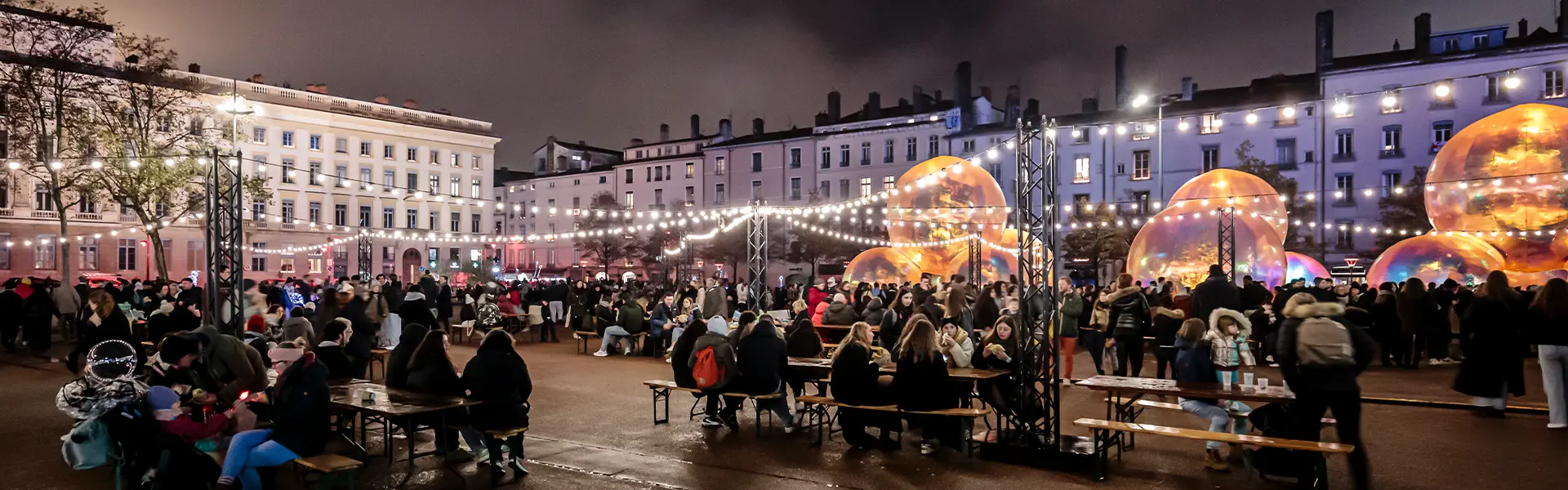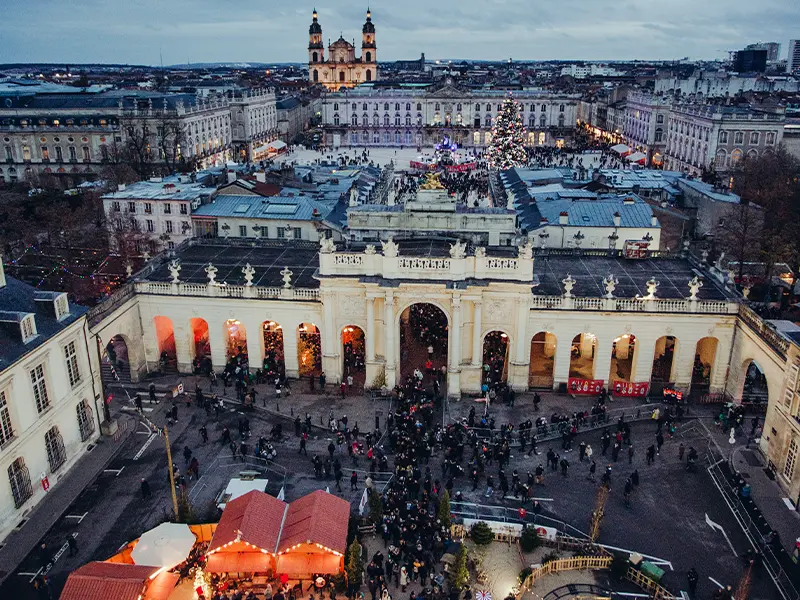
The Saint Nicolas Festival in Nancy is one of the most unusual and frankly quirky Christmas events of France. Nativity plays are replaced with re-enactments about cannibalism in this eastern French city, that’s just an hour and a half from Paris by train says Anna Richards as she traces the history of the unusual Christmas event.
Have yourself a merry scary little Christmas!

Krampus, Hans Trapp, Zwarte Piet — Father Christmas (or St Nicolas, as he was originally known) has many nemeses across Europe. The Father Christmas we know today, rotund yet still mysteriously capable of sliding down the chimney with much more elegance than Bridget Jones on a fireman’s pole, jolly and dressed in red, is a modern creation. If you don’t consider it Christmas until the illuminated Coca-Cola float crosses your TV screen, you’re not wrong. Father Christmas as we know him was arguably the cleverest marketing campaign in history, created by Coca-Cola. His predecessor was St Nicolas, and St Nicolas Day, December 6th, is celebrated with more zeal than Christmas in many parts of Europe, including Lorraine, France.
Here, St Nick’s adversary doesn’t have horns, red eyes and fangs like Austria’s Krampus. He is vagabond-like, dressed in grubby rags and a hooded cape, with dirt smeared across his face. If bad children are lucky, they might receive everything they need to make a winter soup: turnips or potatoes. If they’ve been really bad, they’d better watch out for his enormous whip, lest Père Fouettard (Father Flog) live up to his name.
The cannibal butcher of Nancy – a Christmas story!

One of the biggest St Nicolas Day celebrations is held in Nancy, and the story of St Nicolas is projected onto the handsome buildings of Place Stanislas, Nancy’s main square. It’s a bit like a Halloween slasher set to slightly eerie choral singing, and could easily confuse first-timers. Who is the butcher, and why is he dismembering, salting and curing three children into lardon-like chunks?
Nancy’s cannibal butcher and Père Fouettard are one and the same, but to find out how the two became intertwined requires retracing the region’s entire history.
Who was Saint Nicolas?
One of the most famous Christian saints, St Nicolas was said to have been a bishop, born in Turkey in the 3rd century CE. There are countless legends about his life, but one of the most famous involves three Constantine generals falsely accused of inciting rebellion. The soldiers had been sentenced to death, until St Nicholas appeared and revealed that the juror had been bribed.
In 1087, Italian merchants raided his tomb in Myra, Turkiye, and took his remains to Bari, Italy. St Nicholas was the saint of sailors, merchants, children and the unmarried, among many others, and his body was a source of great interest for many. Among them was a lord of Lorraine, who during the first crusade, stole St Nicolas’ severed fingertip from its new home in Bari, brought it back to his homeland and built a church around it in St-Nicolas-de-Port, 12 km from Nancy. In the 11th century, Nancy was still a swamp. It’s hard to believe now, the gold gilding and mix of Baroque, rococo and Art Nouveau architecture is certainly more Princess Fiona’s ancestral home than Shrek’s.
By the 15th century, trade had pulled Nancy out of the marshes, but it was still far from the rich, attractive city it is today. Charles the Bold opposed Louis XI and tried to make Burgundy an independent state, and in 1476 he set his sights on Nancy. It should have been an easy conquest, but Nancy held out, citizens resorting to eating rats to survive. Local historians and guides believe that some were desperate enough to turn to cannibalism. The Duke of Lorraine, René II, prayed for deliverance, and against all odds Nancy withstood the siege and won the battle. St Nicolas’s status as patron saint of Lorraine was firmly cemented.
Père Fouettard
Less than a century later another Charles set his sights on Lorraine. Charles Quint, Holy Roman Emperor, King of Spain and Archduke of Austria targeted Metz, just over 50 km from Nancy. To taunt him, the city’s tanners, who used whips to tan their hides, created a grotesque puppet of Charles Quint which they paraded through the streets. The puppet became known as Père Fouettard.
As the stories were told, largely orally, tales of cannibalism during Nancy’s 15th century siege and Metz’s 16th century Père Fouettard got mixed up. The butcher’s name may have had something to do with it. Legend had it that the cannibal butcher was called Pierre Lenoir, and he allegedly chopped up and ate children. Pierre Lenoir translates as Peter Black in English, or Zwarte Piet in Dutch — the same as the Dutch nemesis of St Nick.

Throughout December, the resulting amalgamated story is played out in projections on Nancy’s Place Stanislas. A butcher welcomes in three lost children, before slicing them up and putting the chunks in a salting barrel to marinate for seven years. It’s at this point that St Nicolas pays the butcher a visit, and he’s hungry. The butcher may be vicious, but he’s no fool, and he recognises such a holy man instantly. The only food he has to offer is the (now extremely well cured) children in a salting barrel, but he can’t offer this to St Nick. All-knowing St Nicolas places three fingers on the barrel and resurrects the three children, whole and untroubled, as though they’ve awoken from a long sleep. The butcher becomes Père Fouettard, St Nick’s grim sidekick.
The Saint Nicolas Festival in Nancy

The main celebrations for the Saint Nicolas Festival in Nancy take place on the weekend closest to December 6th, when Père Fouettard and St Nicolas take to the streets to hand out coal and turnips to children (Father Flog) or sweets (St Nick). The spectacle culminates when St Nicolas arrives on the balcony of the magnificent Hôtel de Ville. The mayor gives him the keys to the building and the Christmas trees, Christmas lights and streetlights burst into life, and none of the children, real or fictional, seem in the least bit traumatised from their cannibal-themed nativity play!
Find out more about this fabulously fun festival at nancy-tourisme.fr/en
Anna Richards is a writer & guidebook author living in Lyon. Her work has appeared in Lonely Planet, National Geographic and many more.
Want more France?
Discover more fabulous destinations in France with our free magazine The Good Life France
Love France? Have a listen to our podcast – everything you want to know about France and more!
All rights reserved. This article may not be published, broadcast, rewritten (including translated) or redistributed without written permission.