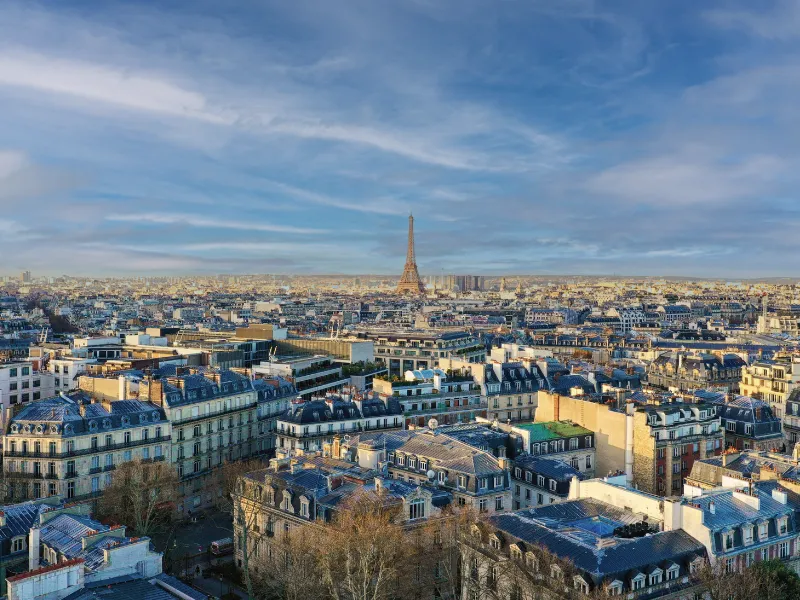
Discover the best Paris neighborhoods to live in from those who live and work there. The French capital is a vast and truly diverse city. Home to over two million people and covering more than 105 km² (41 square miles), you could easily believe that you’re in a different part of the country as you move from one side of the metropolis to the next.
Originally a walled city, Paris has evolved over the centuries but still retains traces of its rich historic past, from impressive monuments to winding cobbled streets. The city is organised into twenty numbered arrondissements, which are city districts similar to neighbourhoods.
“When talking about where you live in Paris, you automatically refer to your arrondissement,” explains Emma Skoble, of Metropolitan Properties Paris. “You’ll hear people explain, ‘I live in the 6th’ or ‘We’re in the Latin quarter’. Parisians also say whether they live north or south of the Seine: north is known as the Rive Droite or right bank, and south is the Rive Gauche or left bank. It’s all part of the Parisian property jargon!”
So if you’re looking to buy a place in Paris, how do you know where to look? Here’s an overview of some of the key Parisian neighbourhoods from a real-estate professional.
Property hot spots in Paris

“The most expensive areas in Paris are south of the Seine,” says Emma, “spanning from the Eiffel Tower to the Jardins du Luxembourg park. These 6th and 7th arrondissements top the list in desirability and therefore price per square metre, but if you have the budget, these areas are ideal for an elegant pied-à-terre in Paris, complete with charming streets of art galleries, antique shops and pavement cafés.”
For a premium property along the riverfront, prices can be stratospheric, but it is possible to buy a two-bedroom property further south, near the Luxembourg Gardens, for around 1.8 million euros.A three-bedroom apartment in the 6th arrondissement (west or north of the Gardens) would easily exceed 2.5 million euros.
In the 7th arrondissement, you can get a two-bedroom, 85m² apartment with a small balcony for 2 million euros. The most south-after locations are around the Carré des Antiquaires, Champs de Mars, Invalides and Rue Cler, and of course any property with a view of the Eiffel Tower fetches a premium!
The most central places to live in Paris
The first arrondissement is where you’ll find iconic landmarks including the Louvre Museum, the Tuileries Garden and the Palais Royal, but it’s also home to upscale designer boutiques, terribly chic cafés and of course residential buildings. Properties rarely come up for sale here, and this prime location comes with a price-tag to match: a modest 50m² studio apartment will fetch around 1.1 million euros.
Just to the north, the second arrondissement shifts from grand boulevards to a tangle of narrow streets, historic arcades, market stalls and wine bars. Back in the 1100s, this area was home to the city’s merchants and it is still home to several wholesale shops as well as Paris’ stock exchange, la Bourse. As you might imagine, it has shed its trade roots and now offers a solid real-estate investment. The grittier neighborhoods around Saint Denis offer the best value for money, with prices climbing as you approach Rue Réaumur and the sought-after streets around Rue Montorgueil, where a 50m² studio can fetch €850,000. The most prestigious and therefore priciest part of the second arrondissement is near the Garnier Opera and rue de la Paix, where 50m² apartments are priced around 1.3 million euros.
The trendy Marais

“The 3rd and 4th arrondissements are known as Les Marais, and it’s the third most expensive area in Paris,” says Emma. “This part of Paris encompasses everything from trendy eateries and hipster hangouts to hidden parks, art galleries and boutique shopping. The north of the Marais is generally a little cheaper, although prices are rising thanks to renovation work here, and property prices are higher as you move into the historic Marais or near République. Here, a 50m² Parisian studio starts at €600,000 but can reach €1,200,000 depending on location and condition. If you’re looking for a good-value property in Paris, try the lively, village-like parts of the Marais, and look to the neighborhoods in Village Saint Paul and north of Place des Vosges for the rare, quieter streets.”
Luxury living in Paris
Anyone hunting for luxury living in Paris should head to the 8th arrondissement, on the opposite riverbank from the Eiffel Tower. This is an opulent area of high-end shopping, 5-star hotels, Michelin-starred restaurants and glamorous clubs.
“The area known as the ‘golden triangle’ is bordered by the metro stations of Étoile, Concorde, and Pont l’Alma, and this is where you’ll find the most glamorous locations,” Emma says. “Apartments on the famous Avenue Montaigne can sell for over €30,000 per square metre, so a modest 50m² studio apartment will be priced around 1.5 million euros, with neighboring streets not far behind.”
You can also head to the historically wealthy district around Avenue Hoche and Avenue Friedland, where you’ll find another luxury: apartments larger than 200m². In these areas, you can find a spacious Parisian home at relatively reasonable prices compared to the golden triangle but still within reach of its glamour.
Bohemian Paris

The charming hilltop district of Montmartre is also known as ‘La Butte’, home to the iconic dome of the Sacré-Coeur basilica and the famous Moulin Rouge cabaret. This area was once lived in by Picasso and Dalí, and its steep, winding streets are still lined with sketch artists, painters and flea markets.
“In terms of real estate, buyers need to react swiftly when any Montmartre property comes on the market,” says Emma, “and you’ll often pay steep prices, particularly around Abbesses and Rue Lepic. That said, this location means you can get an apartment with stunning views over Paris. The neighborhood near the Metro Guy Moquet, toward the 17th, is coming to life with bakeries, shops, and a young cosmopolitan feel, so now would be a good time to buy in this part of Paris. You’ll get even more for your budget toward the Goutte d’Or neighborhood, which offers some of the cheapest real estate in Paris and there are two metro stops in Montmartre, keeping it accessible.”
Accessible Paris
The 10th Arrondissement is where you’ll find two of Paris’s major train stations, Gare du Nord and Gare de l’Est, making it an attractive option for convenient pied-à-terres.
“The Canal Saint-Martin used to be a working-class neighbourhood,” explains Emma, “but it has developed, with many factories now transformed into loft-living apartments. In terms of price, the 10th is currently a hot tip for real estate investment in Paris, as property prices are expected to rise dramatically with ongoing gentrification. Prices are climbing near Canal Saint-Martin and Place de la République, but if you’re looking for a more affordable Paris home that’s easily accessible, search around La Villette and Saint-Denis. You can still find a 50m² apartment in the 10th for under €400,000 if you look carefully, while a 100m² new-build loft apartment comes in at around €1,200,000.”
Best Paris neighborhoods to live in
“This truly is such a diverse city that you are almost guaranteed to find your dream home in Paris if you look carefully,” says Emma. “Whether you want an investment property in an up-and-coming area, a luxurious, spacious apartment in the heart of Paris or a modern, studio apartment in easy reach of airports and train stations, you’ll find it. Equally, you’ll find the arrondissement with an atmosphere to suit your personality. Some Paris streets are arty and eccentric, others are filled with historic, elegant real estate and others are trendy and contemporary. It has been said that Paris has it all; when it comes to real estate, that’s probably true!”
For more insights into all the arrondissements, take a look at the Metropolitan Properties Paris guide to Parisian neighbourhoods.