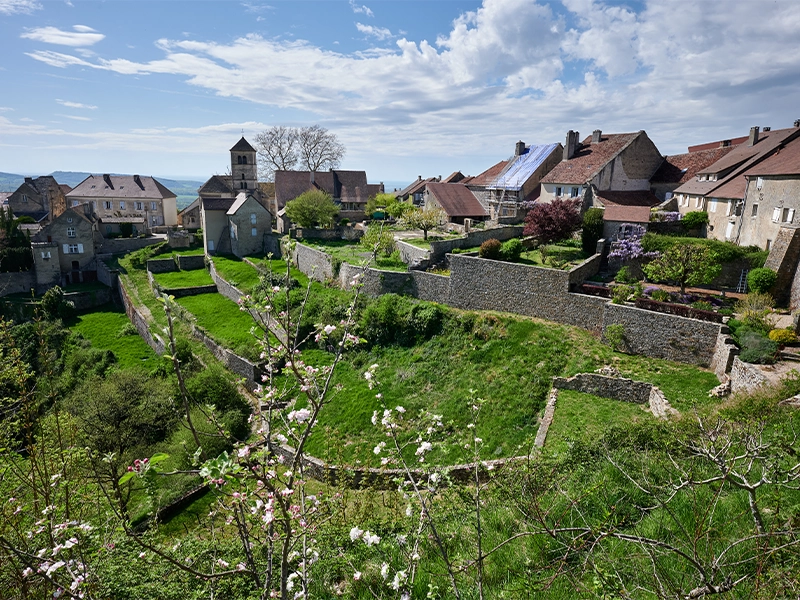
Discover the Jura, an unknown and utterly delicious region in eastern France.
Travelling through Jura, it’s impossible to separate the food, wine and culture from the setting. Here on France’s eastern border, rubbing shoulders with Switzerland, the spectacular sun-drenched landscape of vineyards and woodland is broken abruptly by a series of limestone cliffs. This is the so-called Jura escarpment, which runs across the landscape from north to south and defines the edge of the Jura plateau. Meandering in loops and horseshoe bends these cliffs form a succession of steephead valleys, their rocks separated into bands like a vast layer cake, and taking on hues of orange and gold in the glow of the setting sun. The whole place is almost ridiculously photogenic. It was Jura’s folded, fossil-rich limestone geology which gave its name to the Jurassic era – so it’s tempting to nickname it the original Jurassic Park.
Scattered across this bucolic landscape you’ll find a whole slew of gorgeous villages, several of them carrying the Plus Beaux Villages du France label, dotted with churches, monasteries and masses of cultural interest – and the food and wine are out of this world.
Discover the Jura

Arbois lies around 70km southeast of Dijon, a Petite Cité de Caractère (Little Town of Character) at the heart of the Arbois AOC wine region. The River Cuisance runs through the centre of the town, gliding below old stone bridges, shooting down the occasional weir, and overhung with closely-packed houses. The main landmark is the 12th century Église Saint Just, built in Romanesque and Gothic styles, with a prominent 16th century bell tower visible from afar. Actually the bell tower was originally about 20m higher – Archduchess Margaret of Austria had it built as the tallest one in Jura – but a 17th century fireworks display, unwisely housed in its upper portion, went wrong and blew the top off.
One of the best spots to sit in the sun while soaking up the atmosphere in Arbois is a cluster of tables beside the river, just behind the church – these are served by the bar just across the water, Troquet Les Archives. There are plenty of places in the old town centre to taste and buy local wines – Domaine Rolet for example has an excellent caveau de dégustation.
Louis Pasteur – the great 19th century chemist and microbiologist, whose pioneering work included the development of the earliest vaccines, our modern understanding of the process of fermentation, and the principle of pasteurisation – was born in Dole, in the northwest of Jura. However, he lived in Arbois, and his well-preserved former home, including his private laboratory, is open as the Maison de Louis Pasteur. Though he had an apartment in Paris, this was the only home Pasteur ever owned, which perhaps gives an indication of the affection he felt for the place, set in the centre of the village, on the banks of the river. Pasteur also owned vineyards in nearby Montigny-les-Arsures, which as it happened proved a great setting for the study of micro-bacteria.

Just a little to the east of Arbois, tucked below cliffs at the head of a valley near the source of the Cuisance, there’s a beautiful set of tufa waterfalls, all lush and green with overhanging moss, the water cascading into a broad shallow pool. (Tufa is formed by soluble limestone in the water, which is gradually deposited on the rocks and plants that form the waterfall over hundreds of years.) There’s a little 11th century church nearby, once part of a former Benedictine abbey. We walked to the falls from Arbois, following a path above the cliffs which form the edge of the Jura escarpment, including some breath-taking viewpoints at Belvédère de la Roche de Feu.

Arbois might be the capital of the Jura wine region – but it’s the tiny village of Château-Chalon which is most closely associated with that greatest and most prestigious of Jura wines, Vin Jaune.
Vin Jaune is made from the Savagnin grape, and gets its characteristic, fantastically rich and complex taste from being matured for over six years, in barrels which are not topped up to compensate for evaporation. This creates a pocket of air in the barrel, leading to a film of yeast developing on the wine’s surface. It’s a beautifully rounded wine, with a distinctive nuttiness, and notes of toasted walnuts and almonds, dried fruit, and honey – and it can be aged for decades. Think along the lines of a big plate of morels and ceps as the perfect accompaniment.
Château-Chalon sits perched on the edge of the Jura escarpment, overlooking the valley below – with a Plus Beaux Villages label, and sporting a Romanesque church, plenty of old stone houses, and a keep which is all that remains of a former castle. We reach the village by way of a Roman road, which cuts down across one stretch of the escarpment with razor-like precision. This was the Roman road between Besançon and Lyon, and this section is still laid with large stones worn smooth over the course of two millennia – and here and there still bearing the deep-cut tracks of ancient cart wheels, like a rustic version of a street transposed from Pompeii.
Once in Château-Chalon we do the obvious and very sensible thing – head straight for the garden of Le Bouchon du Château, a popular restaurant at the near side of the village, and order a glass of Vin Jaune – stupendously good, and a rich golden colour in the hot afternoon sun.
Jura has no shortage of cheeses. There’s Comté of course – the town of Poligny, just a 10-minute train ride south of Arbois, is its de-facto capital. But there’s also Mont d’Or, a delicious soft cheese, the origins of which are seasonal – it was traditionally made in winter, when there was less milk, and these small cheeses were on the one hand a more practical alternative to making vast Comté wheels. Mont d’Or has a distinctive, woody flavour. As well as being matured on spruce boards, it is wrapped a strip of spruce bark, and the round box you buy it in is also made of spruce. Some opt to eat Mont d’Or straight out of the box with a spoon (this definitely gets my vote), while others insist that the best way to enjoy it is baked (you put the whole box in the oven) and accompanied by baked potatoes. And Jura wine, of course. Bleu de Gex, also known as Bleu du Haut-Jura, is a surprisingly mild blue cheese from the high valleys of the Upper Jura.
And then there’s Morbier made in two stages, and again something of a winter’s tale. With less milk available in the winter months, farmers would half fill the moulds with the curds from that day’s milking, and cover the surface with a layer of ash to preserve it. Then the following day they’d pour the curds from that day on top to fill the mould, leaving the characteristic dark streak through the centre of the cheese.
Jura is also renowned for its charcuterie, in particular its Morteau and Montbéliard smoked sausages. Morteau, with its aromas of juniper, was the first French product to be awarded PDO certification. Key to these smoked sausages are the local smokehouses (tuyé) – keep an eye out for the large, tell-tale wooden chimney on farmhouses which have a tuyé.
The highlight of this trip to Jura was Baume-les-Messieurs, a tiny village at the meeting point of several steephead valleys which fan out like the fingers of a hand, dark green and framed by a wall of cliffs. The village centres on Baume Abbey, a former Benedictine monastery, re-founded in the 9th century on the site of earlier monastery, by Berno of Baume who later went on to found the great abbey at Cluny. Just across the road from the abbey, Le Grand Jardin is an exceptionally lovely guesthouse and restaurant which makes a perfect base for exploring the surrounding area.
The real showstopper lies a short way up one of the adjacent valleys – the large, fan-like tufa falls here are even more impressive than those at Arbois, while in the cliffs above, you’ll find the entrance to the Grottes de Baume-les-Messieurs, bristling with stalagmites and stalactites, and opening up into chambers reaching up to 80m in height.
And the best way to link up some of the region’s beautiful villages, castles galore, vineyards, foodie hotspots and natural wonders? Arbois, Poligny and Lons-le-Saunier all lie on the train line between Besançon and Bourg-en-Bresse, so it’s a doddle to get here, and just as easy to skip back and forth between them. And they’re also linked by L’Échappée Jurassienne – a hiking trail which unravels itself across Jura from west to east, taking in some of the most beautiful scenery this corner of France has to offer. The ‘Jura Escape’ provides a wonderful way to explore the region at a languid pace – with the added benefit that you can drink all the Vin Jaune you want without having to think about who’s driving. And however you travel, you’re never far from a village or town with plenty of delicious places to eat.
For more info see: Montagnes du Jura en.montagnes-du-jura.fr
Rudolf Abraham is an award-winning travel writer, photographer, author of over a dozen books and has contributed to many more, and his articles and images are published widely in magazines. rudolfabraham.com
Want more France?
Discover more fabulous destinations in France with our free magazine The Good Life France
Love France? Have a listen to our podcast – everything you want to know about France and more!
All rights reserved. This article may not be published, broadcast, rewritten (including translated) or redistributed without written permission.