Capital city of the historic Poitou region, west-central France, Poitiers is a relaxed city with some high-octane thrill options on the doorstep. Gillian Thornton went to find what to see and do in Poitiers.
Strategically situated at a crossroads of trade routes, the Roman town of Limonum was a buzzing place to be around the 1st century AD with an amphitheatre seating more than 30,000 citizens of the Empire. And 2,000 years on, 21st century Poitiers is still an attractive option for a relaxed weekend break or as a stopover on a tour through Nouvelle-Aquitaine.
What to see and do in Poitiers
With its rich history and compact, walkable centre, Poitiers is a delight for lovers of history and heritage, but there is a contemporary vibe too with half of all residents being under 30, thanks to the city’s large student population. And with one of the country’s biggest and best theme parks on the doorstep, plus a brand-new water park, Poitiers is keeping up the ancient Roman tradition of providing a good time for all.

But history is never far away. The amphitheatre was one of the largest in Roman France, though it was demolished in the 1850s to allow for an urban makeover. Today only fragments remain in cellars and incorporated into other buildings, but other traces of the ancient city still paint an intriguing picture.
Museums, monuments and marvellous churches
I am standing in the underground gallery of the Sainte-Croix Museum, where the spirit of the Empire is still tangible thanks to exposed Roman foundations uncovered beneath the former abbey of Sainte-Croix. I have a real sense of people too as I linger over fragments of rare gladiator helmets and a stunning marble statue of Athena discovered by construction workers in 1910.
Poitiers takes its name from a Gallic tribe, the Pictones or Pictavi, who lived in the Oppidum Limonum or ‘hill fort of the elms’ above the river Clain, but there were people here before that. The museum is packed with fascinating archaeological finds including prehistoric limestone slabs engraved with animals, as well as medieval collections, local history and fine art including many works by women artists, amongst them sculptor Camille Claudel, model and lover of Auguste Rodin. Tip: Ask for the Highlights leaflet in English.
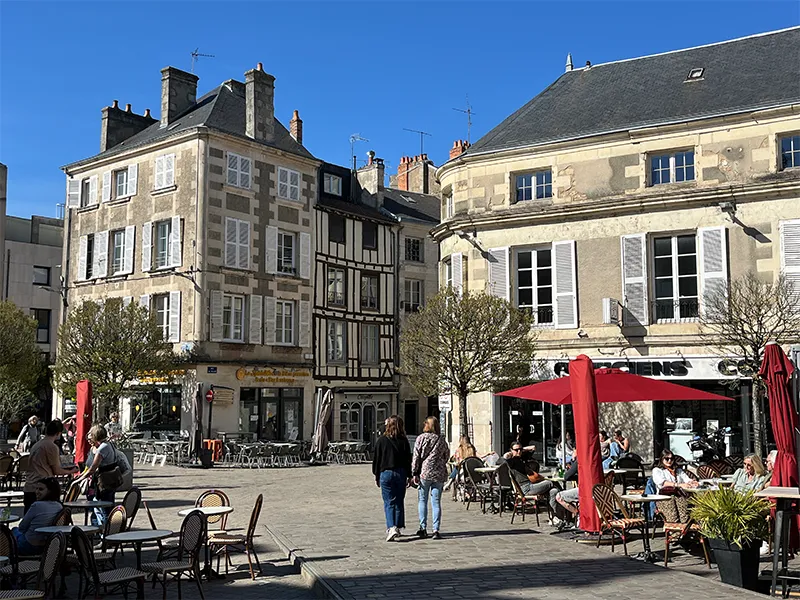
With a current population of around 90,000, Poitiers is small enough to feel intimate and my tranquil base at the Hôtel de l’Europe, part of the reliable Logis network, is ideally placed for exploring the main sites on foot, just a short walk from the Hôtel de Ville that stands behind a large café-lined square. With so many pedestrian streets between the mellow limestone buildings, Poitiers exudes a tangible feeling of calm.

At the highest point of the city on the site of the Roman forum stands Notre-Dame-la-Grande, not in fact the cathedral but probably more famous thanks to its Romanesque design, richly painted interior, and ornately carved façade dating from the 12th century.
The church is closed for major restoration work until May 2027, but you can still view the carvings through the perimeter fence and take a virtual journey inside through an exhibition in the Tourist Office opposite. To explore the city at your own pace, download the free app, Visit Poitiers, that works with GPS as you follow a choice of walking routes to discover heritage sites, local legends and unusual stories.

If you can’t resist the aromas and colours of a French indoor market, pop into Les Halles next door to Notre-Dame, then walk behind the Tourist Office to visit the imposing Palace of the medieval Counts of Poitou and Dukes of Aquitaine. The vast ceremonial hall was built in the 12th century during the residence of Eleanor of Aquitaine, wife of English Plantagenet king Henry II, after her marriage to Louis VII of France was annulled. Joan of Arc was questioned within these walls and the building was later used as the Law Courts. Today it is one of the finest examples of medieval civil architecture in France with its soaring roof, decorated columns and immense fireplaces.
Then head downhill towards the multiple attractions of the cathedral quarter. En route, I stop at François Frères in Grande Rue, one of just five firms in France producing high-quality handmade umbrellas for every occasion and in a tempting variety of styles and colours. Artisan craft at its very best.
Saint-Pierre Cathedral has links to Eleanor and Henry too. They married in 1152 in the Romanesque church that once stood on this spot, commissioning the new cathedral in the 1160s and financing a stained glass window of the Crucifixion, one of the oldest surviving in France. Look out for the royal couple in the bottom panel. Other highlights include the ceiling paintings of the Last Judgement, only discovered in 2008 thanks to a leak in the whitewashed ceiling, and the carved 13th century choir stalls, the oldest in France.

Cross over Rue Jean Jaurès that links the town centre with the river to visit Sainte-Croix Museum and the Saint-Jean Baptistery, one of the oldest surviving in the Western World. Dating from the 5th century and altered many times, the atmospheric interior includes large arches, 12th century wall paintings and a sunken font.
Poitiers was dubbed the ‘City of 100 Spires’ and if you like a church with a legend attached, head to Sainte-Radegonde, close to the banks of the Clain. Queen of the Franks in the 6th century through a forced marriage, Radegonde is said to have slain a winged dragon, the fearsome Grand’Goule or ‘Big Mouth’ who was eating the poor nuns of Saint-Croix Abbey. Today Radegonde is patron saint of passing exams, very useful in a student community like Poitiers, and a medieval painted dragon is on show in Saint-Croix!
Shopping and restaurants
With the main heritage sites concentrated around the town centre, it is easy to combine Roman and Romanesque with retail and restaurant therapy, although sometimes the two go hand in hand. At Zara, inside the Cordeliers shopping mall, I find arches from a 13th century chapel spanning the fashion rails, and Le Nid de Cicognes deli and café boasts arches from an old bridge leading to Eleanor’s Palace.
Hungry? For food-truck fare or just a riverside apéro, head to the Guingette Pictave on Ilot Tison, site of an old sawmill on the Clain. I also enjoy a very different kind of atmosphere beneath the elegant arches of Les Archives, a gourmet restaurant inside a former Jesuit chapel attached to the Hotel Mercure. And meat-lovers should head to Chez Cocotte for succulent steaks from a variety of regional cattle.
Futuroscope, Poitier’s no. 1 attraction
No visit to Poitiers is complete without a visit to Futuroscope (futuroscope.com), a unique theme park offering over 40 attractions and shows that transport visitors across planet Earth and beyond. Expect thrilling roller coasters and immersive 4D experiences, as well as gentler rides for younger visitors. Outside the park gate is Aquascope, an all-year-round water park with eight water slides and four themed universes. All just 20 minutes from Poitiers by car, train or bus. Somehow I think the Romans would have approved!
Gillian flew direct to Poitiers with Ryanair from London-Stansted. The city is 1h15 from Paris by train with a station in the town centre and another at Parc du Futuroscope which is less than 10 minutes from Poitiers via a TER line.
By Gillian Thornton, one of the UK’s leading travel writers and a regular writer for The Good Life France Magazine and website.
Want more France?
Discover more fabulous destinations in France with our free magazine The Good Life France
Love France? Have a listen to our podcast – everything you want to know about France and more!
All rights reserved. This article may not be published, broadcast, rewritten (including translated) or redistributed without written permission